 nom

What the sources say about regular meals
The NHS, the HSE and the British Dietetic Association all write about regular meals, and they write about them for general populations rather than for one eating pattern. The HSE lists eating regular meals and snacks among their healthy eating habits. The NHS advice for IBS includes not delaying or skipping meals. The British Dietetic Association suggest eating three regular meals a day, and trying not to skip any meals or to eat late at night.
The NHS also has a line in their weight advice that is worth repeating, because it is blunt: do not skip meals, because you might end up snacking more because you feel hungry. And their Eatwell Guide says the balance of food does not have to be right at every meal, only over a day or even a week.
These are general statements. They are not a verdict on one meal a day, and this guide does not give one.
Why it is not a simple answer
The same sources are clear about when to involve a clinician. The NHS says to speak to a GP if you have lost weight suddenly, if you have lost weight without changing your diet or exercise routine, or if you use control of food to cope with feelings and other situations, and they note this could be a sign of an underlying health condition. Their IBS page asks for urgent advice if you have lost a lot of weight for no reason, or if you are bleeding.
The NHS IBS advice also includes a plain instruction about fluid: if you keep getting diarrhoea, drink plenty of water to avoid dehydration. And the British Dietetic Association note in their fact sheet that IBS is common, affecting around one in five adults, and that other conditions need to be ruled out before IBS is diagnosed.
So the honest answer is that the public guidance describes regular eating, and the exceptions to it are exactly the situations where a clinician is the right person to ask. Nobody reading a website can tell you whether one meal a day suits you, and this guide will not try.
Keeping track without judgement
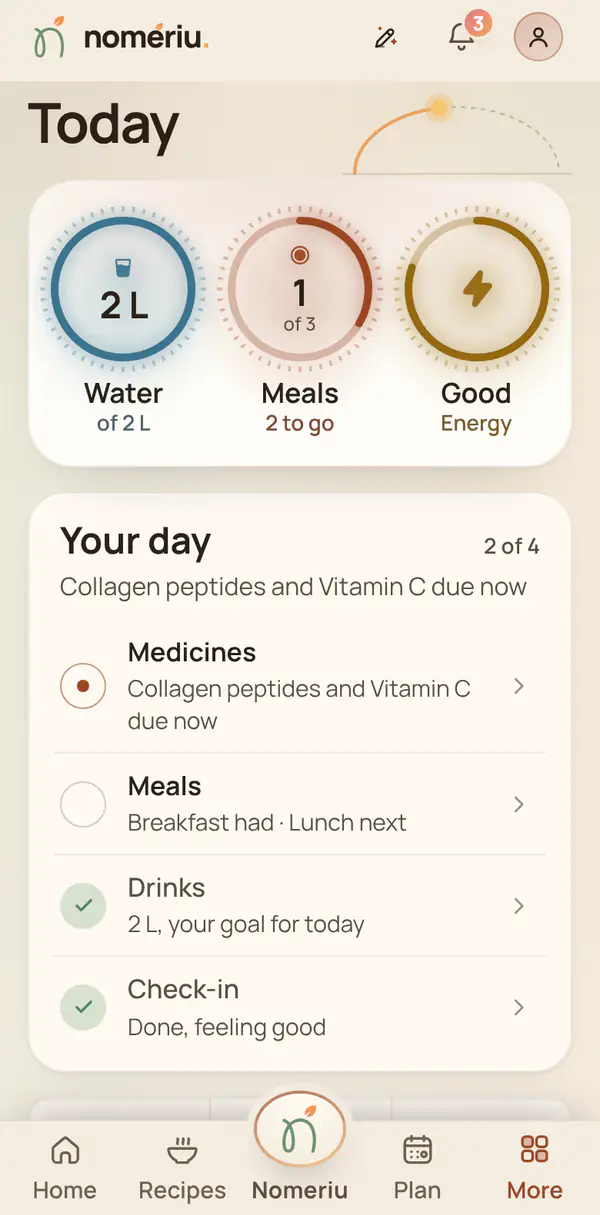
Whatever the pattern, seeing it clearly tends to be more useful than guessing at it. Nomeriu has one tap at the top of Today for a check-in headed How are you today, covering water, meals, sleep and how today feels, with morning, midday and evening check-ins and a Same as yesterday button for the days when nothing much changed.
There are 329 published recipes, each with ingredients, steps, time, servings and per serving nutrition, so you can see what a meal involves before you commit to it. If you do eat once a day, that is useful information when you are choosing what that one meal is.
Pacing in Nomeriu is a daily amount of energy, or spoons, that you set, with the things you do and how much energy each one takes. It is a way of noticing where a day went, which is often the first step in noticing an eating pattern. Everything stays on your device.
Who to ask
Nomeriu is not medical advice. It cannot tell you whether eating once a day is right for you, and it is not able to look at anything but what you put into it.
A GP or a dietitian is the right person for your own situation, especially if you are losing weight, feeling unwell, finding that food has become tied to how you feel, or if you are simply not sure. The NHS links to eating disorders information for anyone who wants to read more, and the British Dietetic Association say that food fact sheets are for information only, not a substitute for medical diagnosis or dietary advice from a dietitian.
If food and your thoughts about it are taking up more room than you would like, that is worth saying out loud to someone whose job it is to listen.
Sources
- NHS: Diet, lifestyle and medicines for IBS Their advice not to delay or skip meals and to drink plenty of water if diarrhoea continues.
- BDA: Irritable bowel syndrome (IBS) and diet Three regular meals a day, not skipping meals, how common IBS is and the note that it is for information only.
- HSE: How to eat well Their list of healthy eating habits, which includes regular meals and snacks.
- NHS: Tips to help you lose weight Their line about not skipping meals and the advice to talk to a GP if you have lost weight without trying.
- NHS: Healthy ways to gain weight When they say to speak to a GP, including if you use control of food to cope with feelings.